Showy Milkweed
Asclepias speciosa Torr.
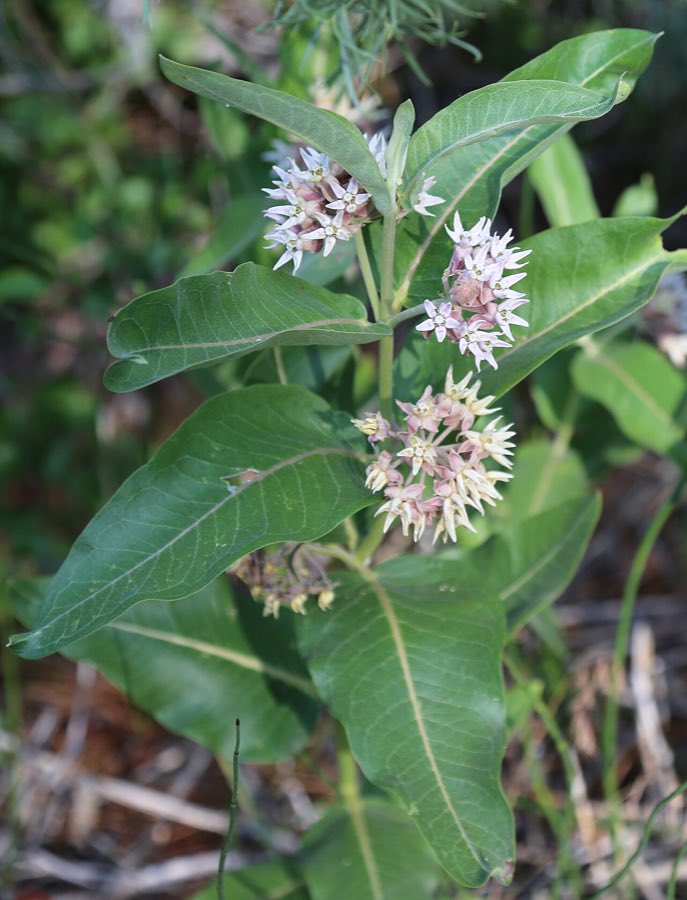
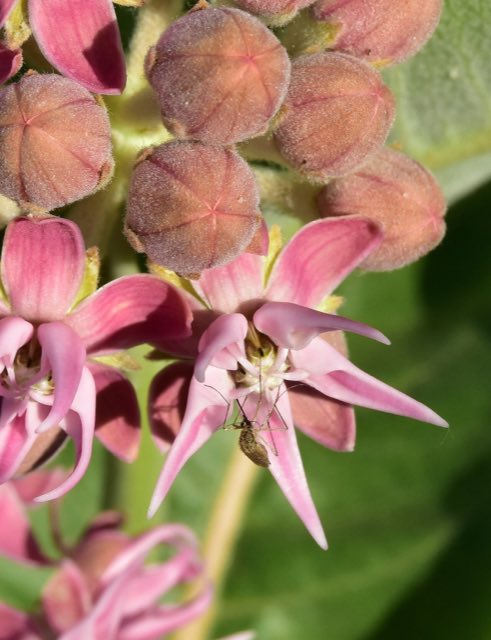
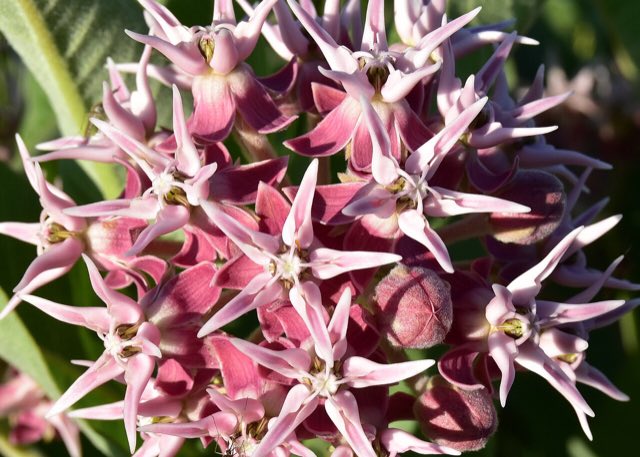
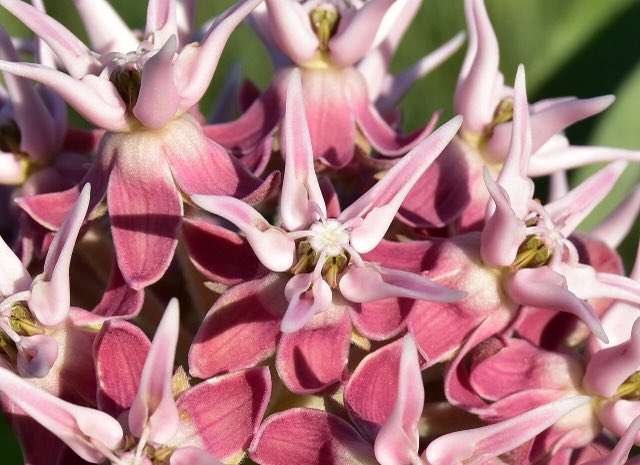
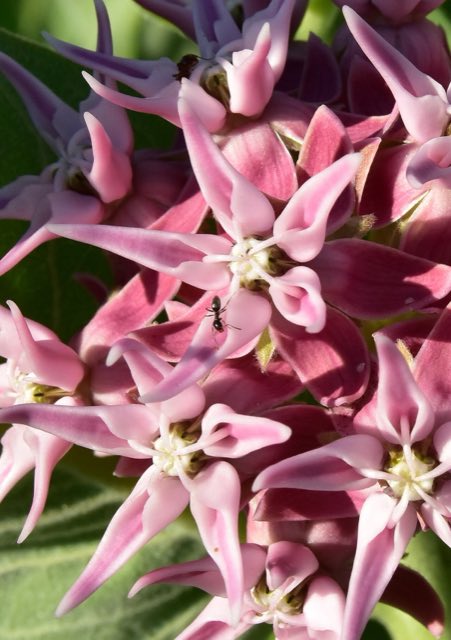
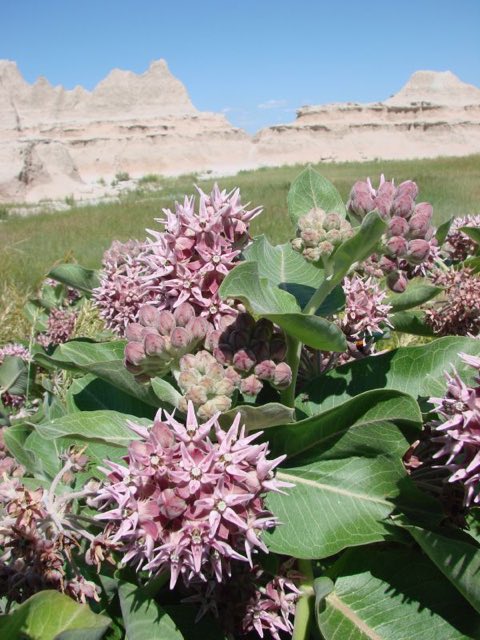
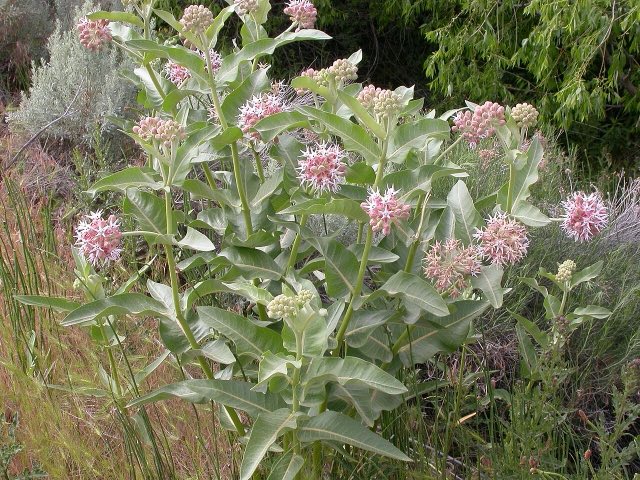
The West’s answer to common milkweed, and the single most important monarch host plant between the Great Plains and the Sierra Nevada. Its flowers are the showiest in the genus: star-shaped, rose-pink, with long pointed hoods that give each cluster a spiky, ornamental look. Gray-green velvety foliage sets it apart at fifty paces.
Also called Greek Milkweed, Creek Milkweed.
- Height
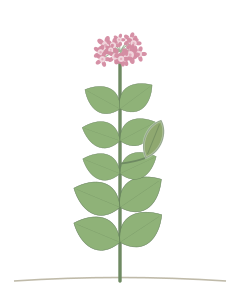
- 2 ft–5 ft
- Spread
- 2 ft–8 ft
- Flowers
- pink, rose
- Bloom
- May to August
- Light
- Full sun
- Soil moisture
- Average, Dry
- USDA zones
- 3–9
- Leaves
- Opposite, ovate
- Sap
- Milky latex
- Roots
- Rhizomatous, spreads by root
- Stratification
- 30 days cold-moist
- Range
- 21 states
When it flowers
Showy Milkweed blooms May to August, peaking in June and July.
How to identify it
- Hoods are long, narrow and sharply pointed, giving the flower head a distinctly starry silhouette. This is the key difference from common milkweed.
- Leaves are thick, gray-green and densely velvety-hairy on both sides.
- Flower clusters are held upright to slightly nodding, not fully drooping.
- Pods are woolly and covered in soft, blunt projections.
Ecology and wildlife value
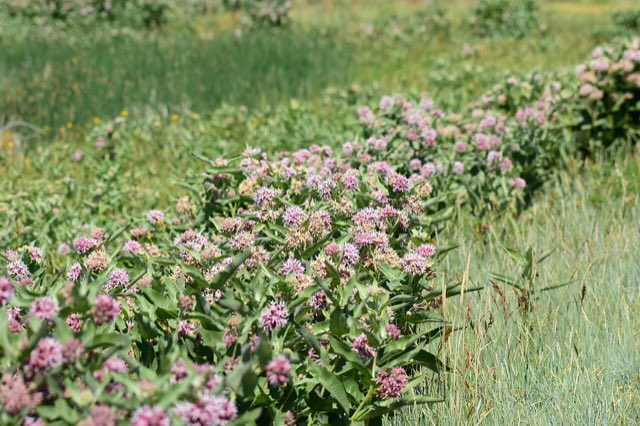
Carries the bulk of western monarch breeding along irrigation ditches, riverbanks and roadsides from the Front Range to the Cascades. Bumble bees, digger bees and hummingbird moths work the flowers heavily. In much of the Intermountain West it is the only large-leaved milkweed available to a female monarch.
Growing showy milkweed
Far better behaved than common milkweed but still rhizomatous, so expect a slowly widening patch rather than a discrete clump. Tolerates alkaline soils, clay, drought and cold. It is the default milkweed for a Colorado, Montana, Idaho or Utah garden, and it looks good enough for a front border.
Seed needs about 30 days of cold-moist stratification. Rhizomatous, spreads by root. See how to plant milkweed seed for the full method.
Cautions
Mildly toxic to grazing animals in quantity. Sap is a skin and eye irritant, so wash hands after cutting stems. More on milkweed toxicity.
Where showy milkweed grows
Recorded in 21 states: Arizona, California, Colorado, Iowa, Idaho, Kansas, Minnesota, Missouri, Montana, North Dakota, Nebraska, New Mexico, Nevada, Oklahoma, Oregon, South Dakota, Texas, Utah, Washington, Wisconsin, Wyoming.
Distribution is generalized to state level. For county-level maps see USDA PLANTS and BONAP.
Frequently asked questions
Is showy milkweed good for a home garden?
Yes, with room. It is more ornamental and much less rampant than common milkweed, but it still spreads by rhizome. Give it a bed at least six feet across, or plan on pulling shoots.
How do I tell showy milkweed from common milkweed?
Look at the flower. Showy milkweed has long, tapering, sharply pointed hoods that make the cluster look starry; common milkweed’s hoods are short and rounded. Showy milkweed leaves are also greyer and more velvety.
References and further reading
Names, ranges and conservation status here are drawn from the databases below. Where those disagree with a regional flora, trust the flora.
- Plants of the World Online 94654-1. Royal Botanic Gardens, Kew. Accepted name, authorship and global distribution.
- GBIF 3170260. Global Biodiversity Information Facility. Aggregated occurrence records.
- iNaturalist 62292. Community observations, photographs and phenology.
- Wikipedia. General-audience article on this species.
- BONAP county distribution map. Biota of North America Program. County-level range map.
- NatureServe Explorer. Conservation status ranks at global and state level.
- World Flora Online. Nomenclature and synonymy.
- Woodson, R. E. (1954). The North American species of Asclepias L.. Annals of the Missouri Botanical Garden 41(1): 1–211. The monograph the modern taxonomy of the genus still rests on. View
- Flora of North America Editorial Committee (eds.) (2026). Flora of North America North of Mexico. Oxford University Press, New York and Oxford. Accepted names, keys and descriptions for the North American flora. View
- Royal Botanic Gardens, Kew (2026). Plants of the World Online. Facilitated by the Royal Botanic Gardens, Kew. Nomenclature and global distribution, keyed to IPNI name identifiers. View
- Kartesz, J. T. (Biota of North America Program) (2026). North American Plant Atlas. BONAP, Chapel Hill, North Carolina. County-level distribution maps, the basis for the ranges generalized here. View
- USDA, NRCS (2026). The PLANTS Database. National Plant Data Team, Greensboro, North Carolina. State-level distribution, wetland status and nomenclature. View
- Agrawal, A. A. (2017). Monarchs and Milkweed: A Migrating Butterfly, a Poisonous Plant, and Their Remarkable Story of Coevolution. Princeton University Press. The standard general account of the milkweed and monarch relationship. View
Cite this page
This page is licensed CC BY 4.0. Quote it, adapt it and reuse it, including commercially, as long as you credit Milkweed USA and link back.
Milkweed USA. (2026). Showy Milkweed (Asclepias speciosa). Retrieved DATE, from https://milkweedusa.com/species/showy-milkweed/
"Showy Milkweed (Asclepias speciosa)." Milkweed USA, 2026, https://milkweedusa.com/species/showy-milkweed/. Accessed DATE.
Milkweed USA. "Showy Milkweed (Asclepias speciosa)." Last modified 2026-08-01. Accessed DATE. https://milkweedusa.com/species/showy-milkweed/.
@misc{milkweedusa_speciesshowymilkweed,
  title  = {Showy Milkweed (Asclepias speciosa)},
  author = {{Milkweed USA}},
  year   = {2026},
  url    = {https://milkweedusa.com/species/showy-milkweed/},
  note   = {Accessed DATE}
}