Swamp Milkweed
Asclepias incarnata L.
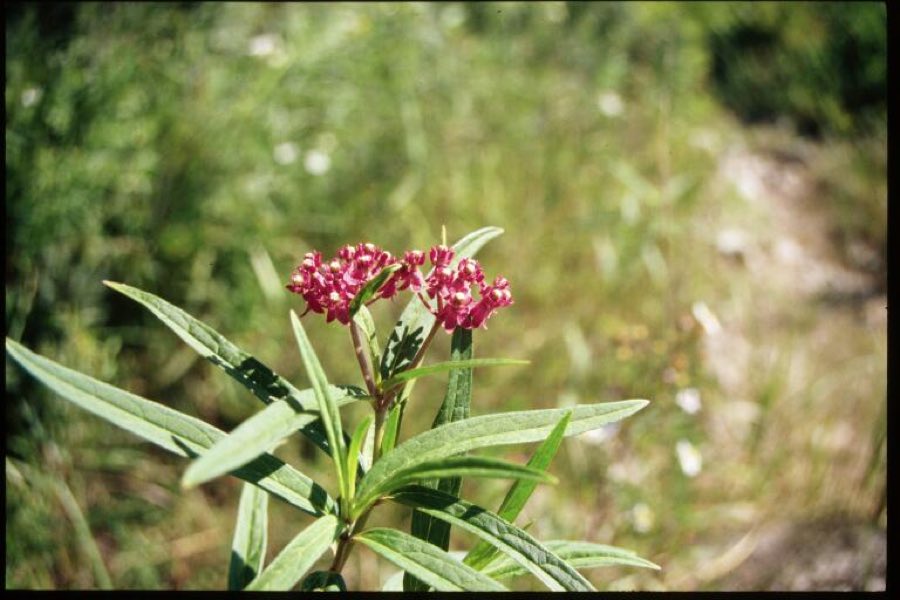
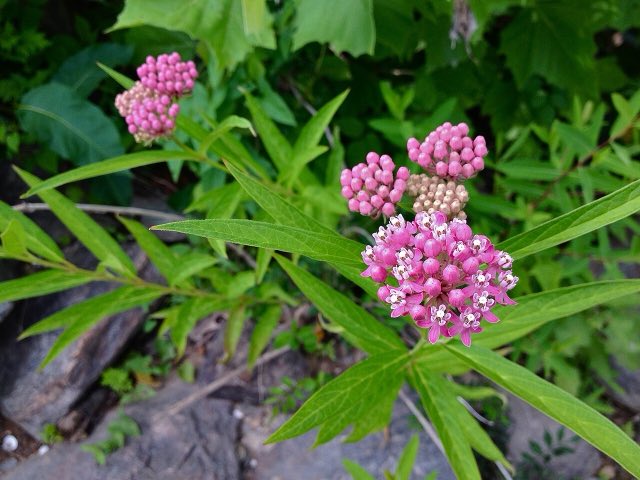
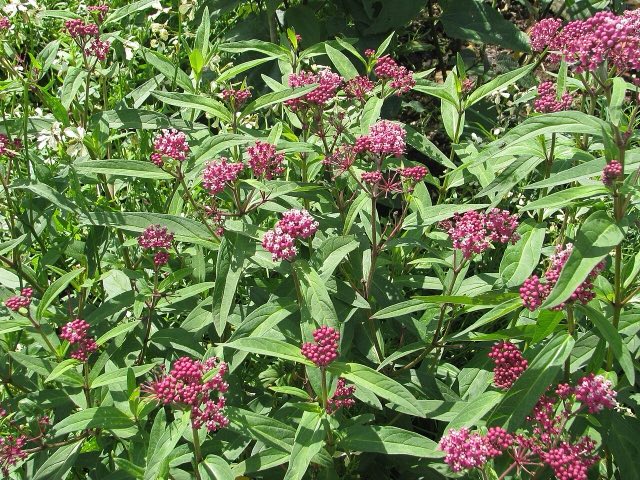
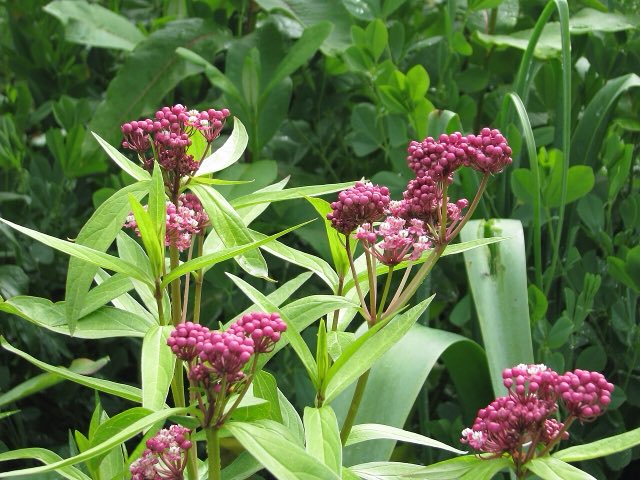
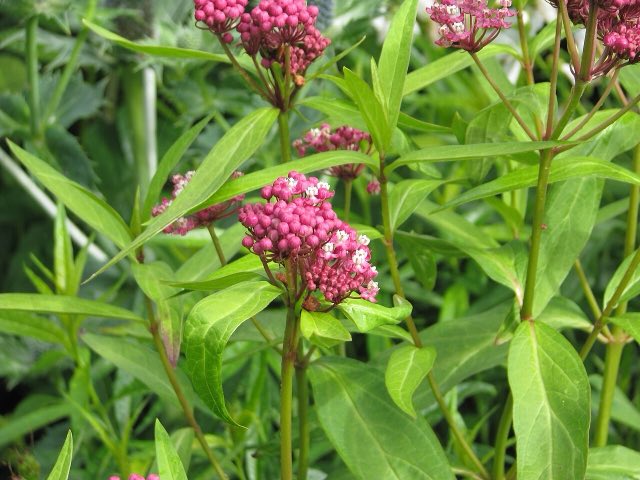
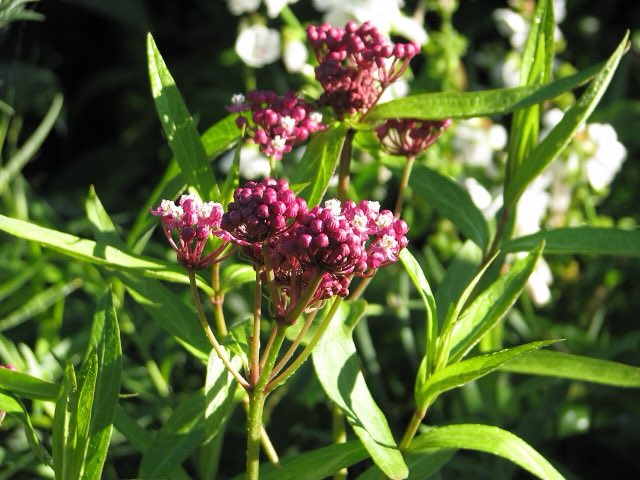
The best-behaved milkweed there is: a tidy, clump-forming, non-running perennial with narrow willow-like leaves and domed clusters of vivid rose-pink flowers that smell faintly of cinnamon. It grows in wet ground in the wild but is perfectly happy in ordinary garden soil, which makes it the safest choice for a border.
Also called Rose Milkweed, Marsh Milkweed, Pink Milkweed.
- Height
- 3 ft–5 ft
- Spread
- 2 ft–3 ft
- Flowers
- pink, rose, white
- Bloom
- June to September
- Light
- Full sun, Part shade
- Soil moisture
- Wet, Average
- USDA zones
- 3–9
- Leaves
- Opposite, lanceolate
- Sap
- Milky latex
- Roots
- Fibrous, clump-forming and easy to move
- Stratification
- 30 days cold-moist
- Range
- 43 states
When it flowers
Swamp Milkweed blooms June to September, peaking in July and August.
How to identify it
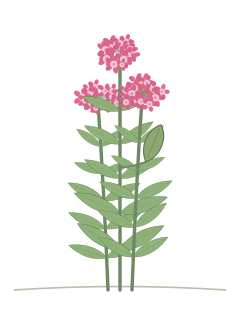
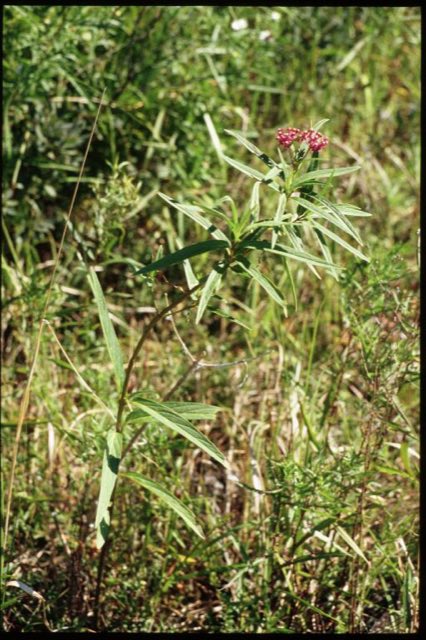
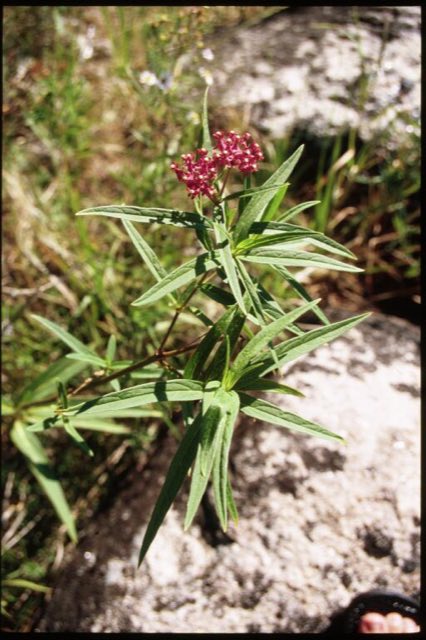
- Narrow, smooth, willow-like leaves on a slender stem that branches near the top.
- Flowers are a much brighter, cleaner pink than common milkweed, in neat rounded clusters held upright.
- Pods are slim, smooth and spindle-shaped, never warty.
- Forms a discrete crown; it does not send up shoots away from the plant.
Ecology and wildlife value
Excellent monarch host and outstanding late-season nectar plant, blooming when common milkweed has finished. Great spangled fritillaries, tiger swallowtails and long-tongued bees dominate the flowers. Because it holds foliage late and stays soft, it often carries the last monarch generation of the year in the Midwest and Northeast.
Growing swamp milkweed
The one to plant if you only plant one. It stays where you put it, tolerates clay, standing water and rain gardens, and takes ordinary garden watering without complaint. Slow to emerge in spring. Cut back in late winter. Divides easily, unlike its taprooted relatives. The white form ‘Ice Ballet’ and compact ‘Cinderella’ are widely sold.
Seed needs about 30 days of cold-moist stratification. Fibrous, clump-forming and easy to move. See how to plant milkweed seed for the full method.
Cautions
Low toxicity risk in gardens. Aphid magnet. Expect orange oleander aphids, and leave them for the ladybirds rather than spraying, which kills monarch eggs. More on milkweed toxicity.
Where swamp milkweed grows
Recorded in 43 states: Alabama, Arkansas, Colorado, Connecticut, District of Columbia, Delaware, Florida, Georgia, Iowa, Illinois, Indiana, Kansas, Kentucky, Louisiana, Massachusetts, Maryland, Maine, Michigan, Minnesota, Missouri, Mississippi, Montana, North Carolina, North Dakota, Nebraska, New Hampshire, New Jersey, New Mexico, New York, Ohio, Oklahoma, Pennsylvania, Rhode Island, South Carolina, South Dakota, Tennessee, Texas, Utah, Virginia, Vermont, Wisconsin, West Virginia, Wyoming.
Distribution is generalized to state level. For county-level maps see USDA PLANTS and BONAP.
Frequently asked questions
Does swamp milkweed need a swamp?
No. It is adapted to wet ground but grows well in average garden soil with normal watering. It simply will not tolerate prolonged drought the way butterfly weed does.
Is swamp milkweed aggressive?
No. It is fibrous-rooted and clump-forming, the least aggressive of the widely grown milkweeds and the right choice for a mixed perennial border.
When does swamp milkweed bloom?
Mid to late summer, typically July into September, later than common and showy milkweed. That makes it valuable for the final monarch generation of the season.
References and further reading
Names, ranges and conservation status here are drawn from the databases below. Where those disagree with a regional flora, trust the flora.
- Plants of the World Online 94351-1. Royal Botanic Gardens, Kew. Accepted name, authorship and global distribution.
- GBIF 3170266. Global Biodiversity Information Facility. Aggregated occurrence records.
- iNaturalist 125381. Community observations, photographs and phenology.
- Wikipedia. General-audience article on this species.
- BONAP county distribution map. Biota of North America Program. County-level range map.
- NatureServe Explorer. Conservation status ranks at global and state level.
- World Flora Online. Nomenclature and synonymy.
- Woodson, R. E. (1954). The North American species of Asclepias L.. Annals of the Missouri Botanical Garden 41(1): 1–211. The monograph the modern taxonomy of the genus still rests on. View
- Flora of North America Editorial Committee (eds.) (2026). Flora of North America North of Mexico. Oxford University Press, New York and Oxford. Accepted names, keys and descriptions for the North American flora. View
- Royal Botanic Gardens, Kew (2026). Plants of the World Online. Facilitated by the Royal Botanic Gardens, Kew. Nomenclature and global distribution, keyed to IPNI name identifiers. View
- Kartesz, J. T. (Biota of North America Program) (2026). North American Plant Atlas. BONAP, Chapel Hill, North Carolina. County-level distribution maps, the basis for the ranges generalized here. View
- USDA, NRCS (2026). The PLANTS Database. National Plant Data Team, Greensboro, North Carolina. State-level distribution, wetland status and nomenclature. View
- Agrawal, A. A. (2017). Monarchs and Milkweed: A Migrating Butterfly, a Poisonous Plant, and Their Remarkable Story of Coevolution. Princeton University Press. The standard general account of the milkweed and monarch relationship. View
Cite this page
This page is licensed CC BY 4.0. Quote it, adapt it and reuse it, including commercially, as long as you credit Milkweed USA and link back.
Milkweed USA. (2026). Swamp Milkweed (Asclepias incarnata). Retrieved DATE, from https://milkweedusa.com/species/swamp-milkweed/
"Swamp Milkweed (Asclepias incarnata)." Milkweed USA, 2026, https://milkweedusa.com/species/swamp-milkweed/. Accessed DATE.
Milkweed USA. "Swamp Milkweed (Asclepias incarnata)." Last modified 2026-08-01. Accessed DATE. https://milkweedusa.com/species/swamp-milkweed/.
@misc{milkweedusa_speciesswampmilkweed,
  title  = {Swamp Milkweed (Asclepias incarnata)},
  author = {{Milkweed USA}},
  year   = {2026},
  url    = {https://milkweedusa.com/species/swamp-milkweed/},
  note   = {Accessed DATE}
}