Common Milkweed
Asclepias syriaca L.
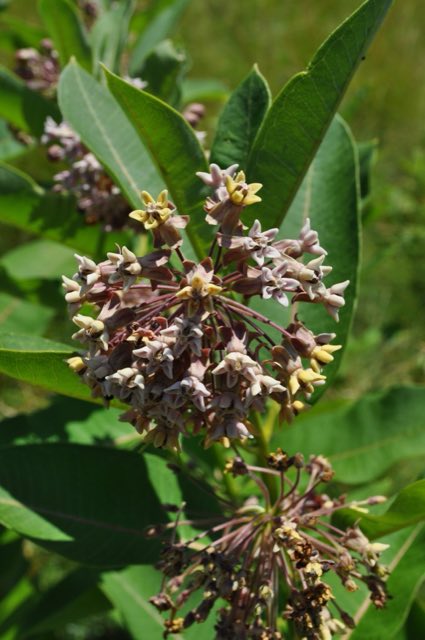
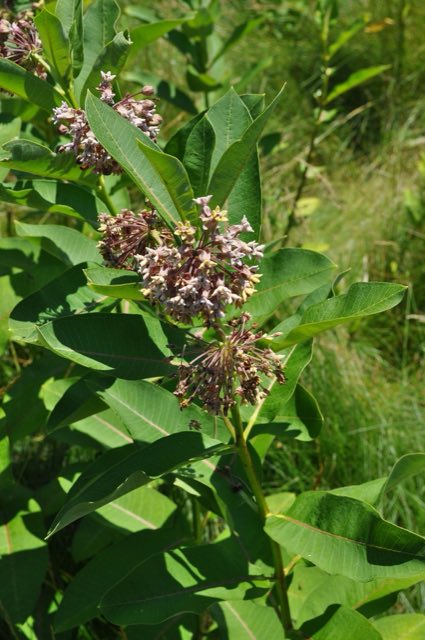
The species that feeds the eastern monarch migration. Big paddle-shaped leaves, thick stems and heavy, drooping balls of dusty-pink flowers with a scent people describe as honey and vanilla. It is also an aggressive rhizomatous colonizer: magnificent in a meadow, a menace in a perennial border.
Also called Silkweed, Virginia Silkweed.
- Height
- 3 ft–6 ft
- Spread
- 2 ft–10 ft
- Flowers
- pink, mauve, white
- Bloom
- June to August
- Light
- Full sun, Part shade
- Soil moisture
- Dry, Average
- USDA zones
- 3–9
- Leaves
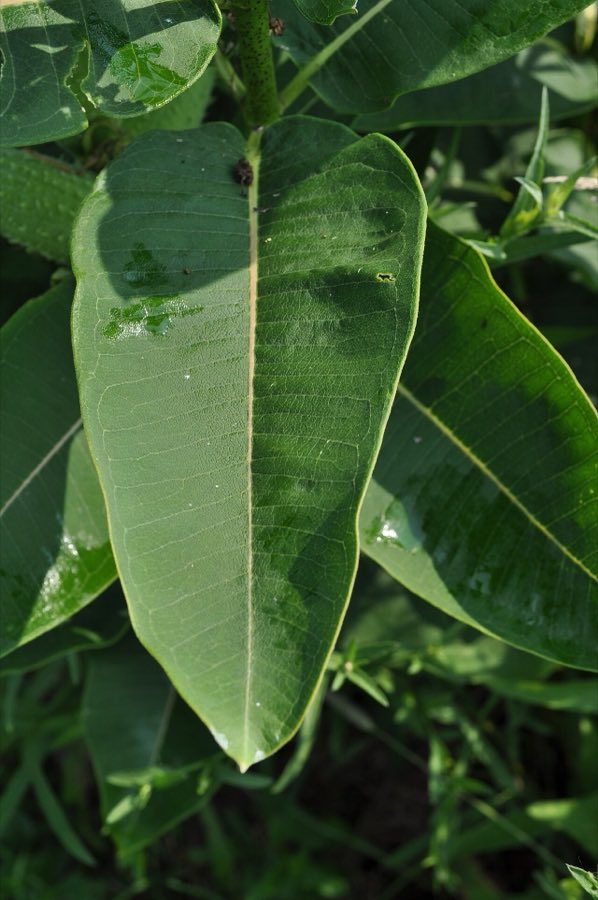
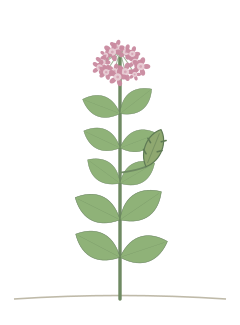
- Opposite, oblong
- Sap
- Milky latex
- Roots
- Rhizomatous, spreads by root
- Stratification
- 30 days cold-moist
- Range
- 40 states
When it flowers
Common Milkweed blooms June to August, peaking in June and July.
How to identify it
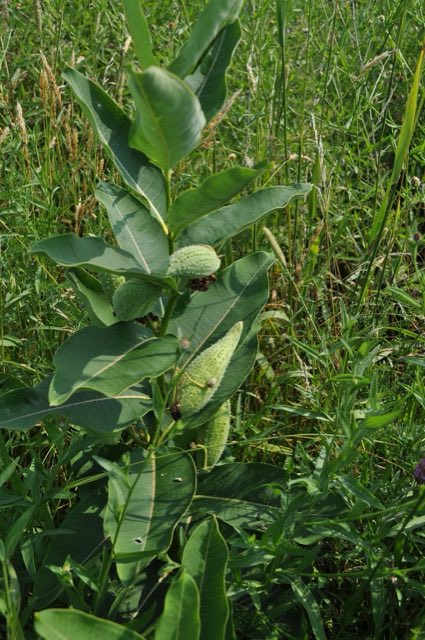
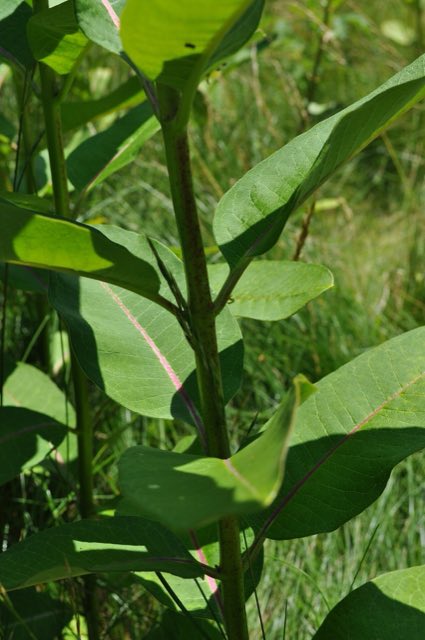
- Leaves are large, broad and oblong with a prominent pale midrib, felted underneath.
- Flower clusters droop or nod rather than sitting flat on top of the stem.
- Stems are stout, usually unbranched, and covered in fine downy hair.
- Seed pods are fat, warty and covered in soft spines, unmistakable in the fall.
Ecology and wildlife value
No plant supports more eastern monarch caterpillars. Large, soft leaves let a single stem raise several larvae, and dense colonies give females an easy target from the air. The flowers are among the richest nectar sources in the North American flora, feeding honey bees, bumble bees, wasps, beetles and butterflies through midsummer.
Growing common milkweed
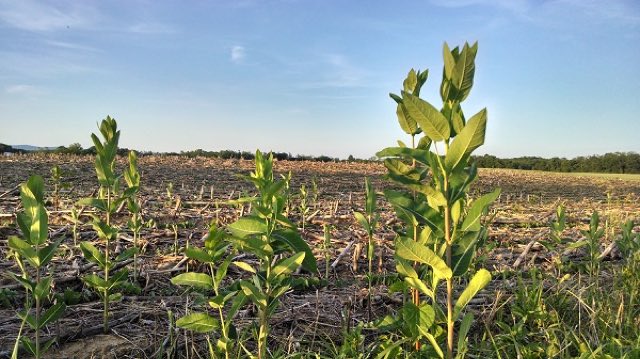
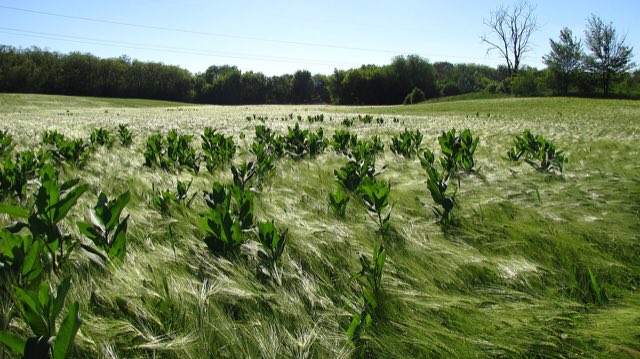
Do not plant it in a small garden unless you intend to fight it. Rhizomes travel several feet a year and shoots pop up through lawns, paths and neighboring beds. In a meadow, hedgerow, ditch or dedicated monarch patch it is the best thing you can grow. Cut stems flush in the fall if you need to slow it, or grow it inside a sunk barrier.
Seed needs about 30 days of cold-moist stratification. Rhizomatous, spreads by root. See how to plant milkweed seed for the full method.
Cautions
Toxic to livestock in quantity, though animals normally avoid it. The tough rhizomes make it a listed noxious weed in a few jurisdictions, so check locally before establishing it on agricultural land. More on milkweed toxicity.
Where common milkweed grows
Recorded in 40 states: Alabama, Arkansas, Colorado, Connecticut, District of Columbia, Delaware, Georgia, Iowa, Illinois, Indiana, Kansas, Kentucky, Louisiana, Massachusetts, Maryland, Maine, Michigan, Minnesota, Missouri, Mississippi, Montana, North Carolina, North Dakota, Nebraska, New Hampshire, New Jersey, New York, Ohio, Oklahoma, Pennsylvania, Rhode Island, South Carolina, South Dakota, Tennessee, Texas, Virginia, Vermont, Wisconsin, West Virginia, Wyoming.
Distribution is generalized to state level. For county-level maps see USDA PLANTS and BONAP.
Frequently asked questions
Is common milkweed invasive?
It is native across eastern and central North America, so it is not invasive in the technical sense, but it is genuinely aggressive. Rhizomes spread several feet per year and it will colonize a bed. Site it where it can run.
How do I stop common milkweed spreading?
Plant it inside a buried root barrier at least 18 inches deep, or grow it in a bottomless container sunk in the ground. Cutting shoots at ground level as they appear will weaken a colony over several seasons.
Common milkweed or showy milkweed: which should I plant?
Longitude decides it. East of the Rockies, common milkweed. West of roughly the 100th meridian, showy milkweed (A. speciosa) is the regional equivalent and the better choice.
References and further reading
Names, ranges and conservation status here are drawn from the databases below. Where those disagree with a regional flora, trust the flora.
- Plants of the World Online 319076-2. Royal Botanic Gardens, Kew. Accepted name, authorship and global distribution.
- GBIF 3170247. Global Biodiversity Information Facility. Aggregated occurrence records.
- iNaturalist 47911. Community observations, photographs and phenology.
- Wikipedia. General-audience article on this species.
- BONAP county distribution map. Biota of North America Program. County-level range map.
- NatureServe Explorer. Conservation status ranks at global and state level.
- World Flora Online. Nomenclature and synonymy.
- Woodson, R. E. (1954). The North American species of Asclepias L.. Annals of the Missouri Botanical Garden 41(1): 1–211. The monograph the modern taxonomy of the genus still rests on. View
- Flora of North America Editorial Committee (eds.) (2026). Flora of North America North of Mexico. Oxford University Press, New York and Oxford. Accepted names, keys and descriptions for the North American flora. View
- Royal Botanic Gardens, Kew (2026). Plants of the World Online. Facilitated by the Royal Botanic Gardens, Kew. Nomenclature and global distribution, keyed to IPNI name identifiers. View
- Kartesz, J. T. (Biota of North America Program) (2026). North American Plant Atlas. BONAP, Chapel Hill, North Carolina. County-level distribution maps, the basis for the ranges generalized here. View
- USDA, NRCS (2026). The PLANTS Database. National Plant Data Team, Greensboro, North Carolina. State-level distribution, wetland status and nomenclature. View
- Agrawal, A. A. (2017). Monarchs and Milkweed: A Migrating Butterfly, a Poisonous Plant, and Their Remarkable Story of Coevolution. Princeton University Press. The standard general account of the milkweed and monarch relationship. View
Cite this page
This page is licensed CC BY 4.0. Quote it, adapt it and reuse it, including commercially, as long as you credit Milkweed USA and link back.
Milkweed USA. (2026). Common Milkweed (Asclepias syriaca). Retrieved DATE, from https://milkweedusa.com/species/common-milkweed/
"Common Milkweed (Asclepias syriaca)." Milkweed USA, 2026, https://milkweedusa.com/species/common-milkweed/. Accessed DATE.
Milkweed USA. "Common Milkweed (Asclepias syriaca)." Last modified 2026-08-01. Accessed DATE. https://milkweedusa.com/species/common-milkweed/.
@misc{milkweedusa_speciescommonmilkweed,
  title  = {Common Milkweed (Asclepias syriaca)},
  author = {{Milkweed USA}},
  year   = {2026},
  url    = {https://milkweedusa.com/species/common-milkweed/},
  note   = {Accessed DATE}
}