Eastwood’s Milkweed
Asclepias eastwoodiana Barneby
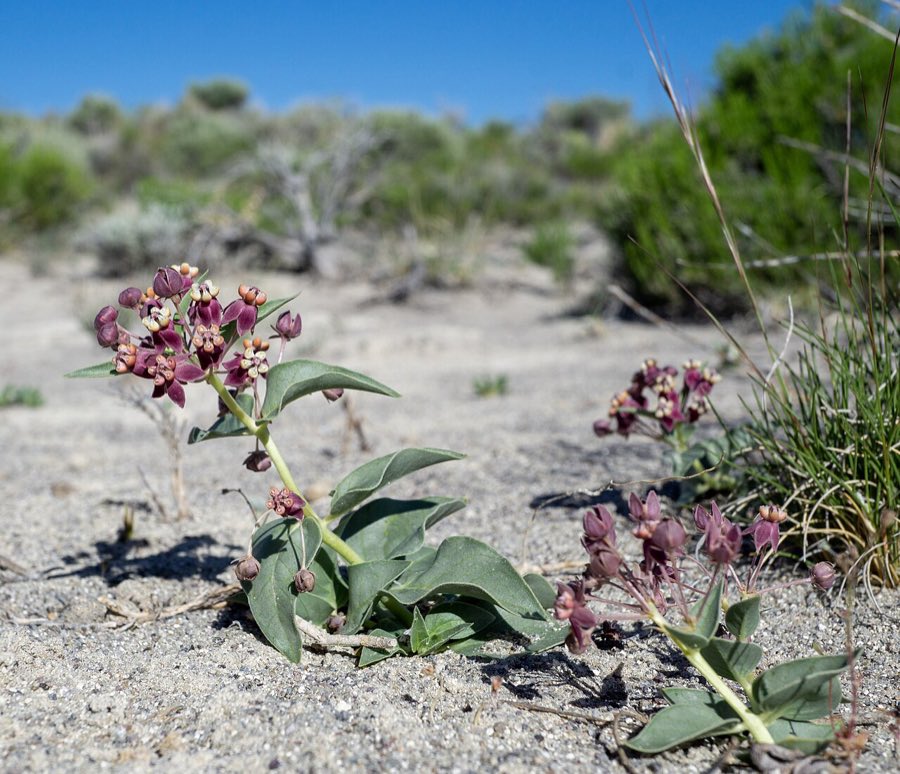
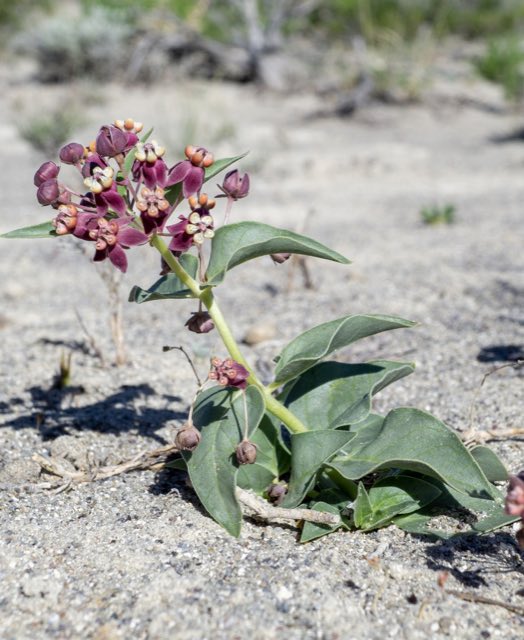
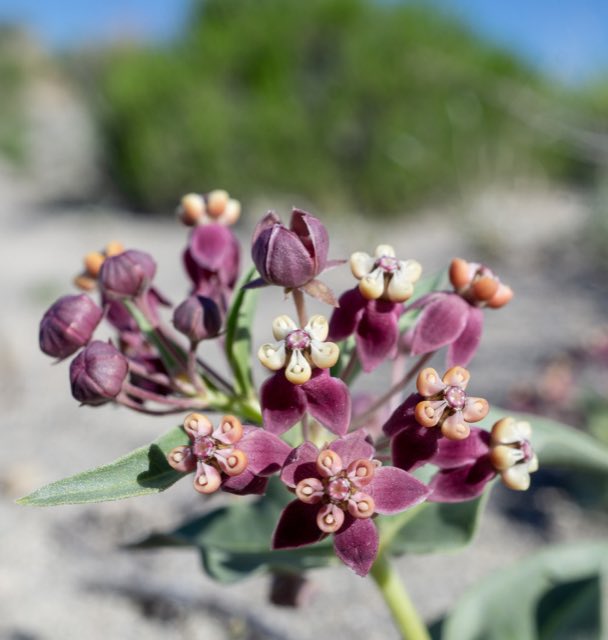
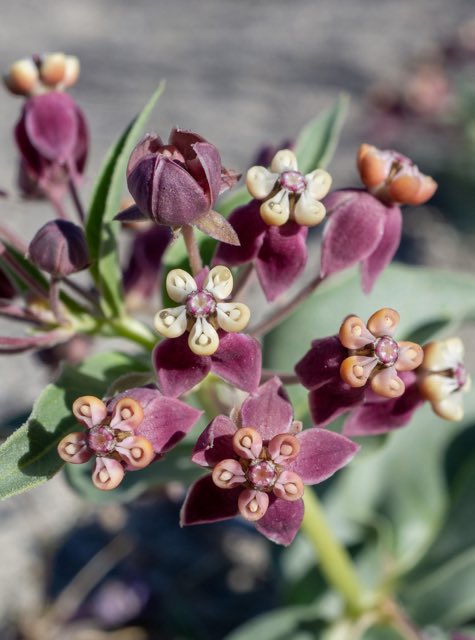
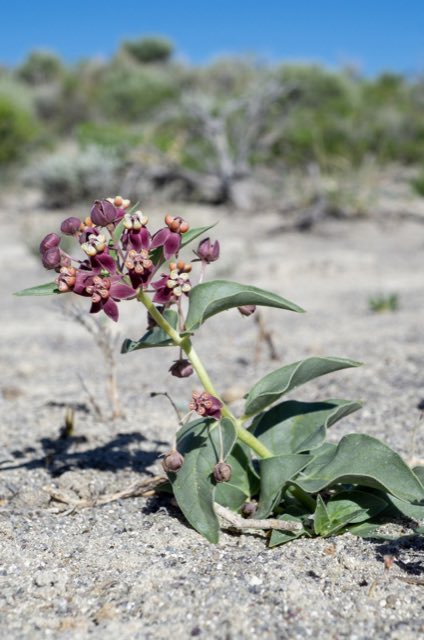
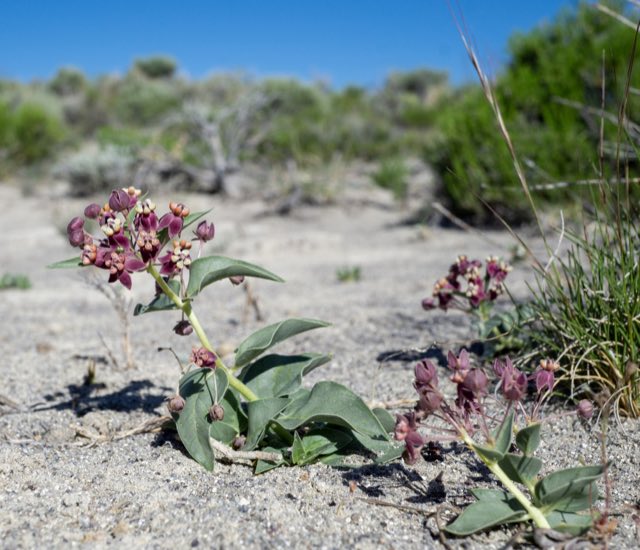
A Nevada endemic of barren volcanic gravel and clay flats in the central Great Basin, forming low gray-green tufts with dusky maroon and cream flowers. Known from a small number of populations and tracked as a sensitive species.
Also called Great Basin Milkweed.
- Height
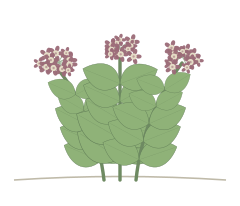
- 6 in–1.2 ft
- Spread
- 10 in–1.7 ft
- Flowers
- maroon, cream
- Bloom
- May to June
- Light
- Full sun
- Soil moisture
- Dry
- USDA zones
- 5–8
- Leaves
- Opposite, ovate
- Sap
- Milky latex
- Roots
- Deep taproot, resents transplanting
- Stratification
- 60 days cold-moist
- Range
- 1 state
When it flowers
Eastwood’s Milkweed blooms May to June, peaking in May and June.
How to identify it
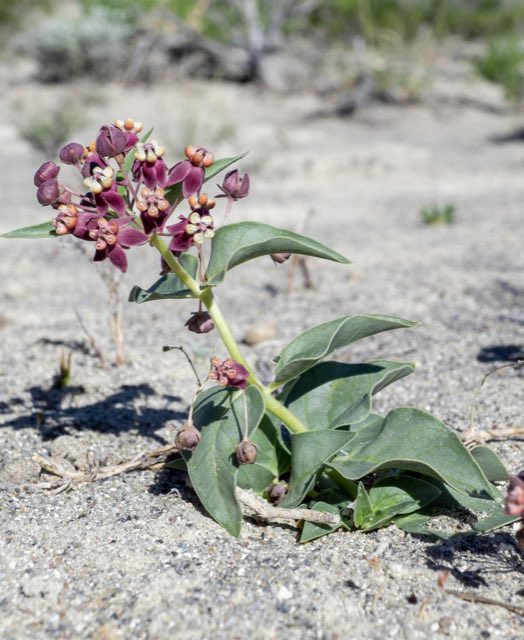
- Low, tufted habit on bare volcanic or ash-derived soils.
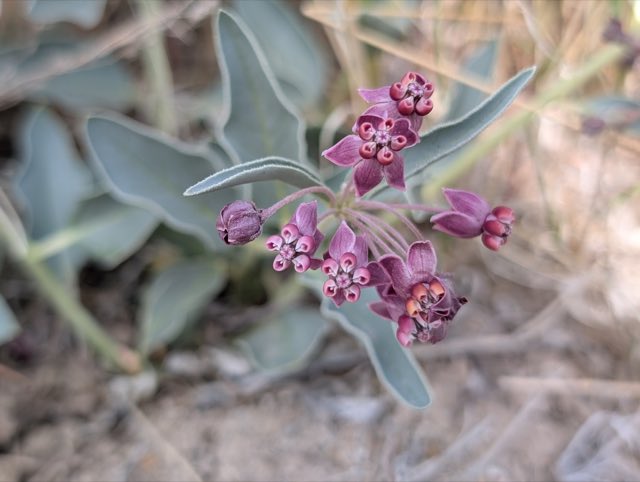
- Greyish, softly hairy, broadly oval leaves.
- Small flowers with maroon corolla lobes and pale cream hoods.
Ecology and wildlife value
A narrow endemic of a habitat type increasingly targeted for mineral exploration. Its pollinators and larval use are poorly documented.
Growing eastwood’s milkweed
Not in cultivation, and should not be collected.
Seed needs about 60 days of cold-moist stratification. Deep taproot, resents transplanting. See how to plant milkweed seed for the full method.
Cautions
A restricted Nevada endemic. Record and report sightings rather than collecting. More on milkweed toxicity.
Where eastwood’s milkweed grows
Recorded in 1 state: Nevada.
Distribution is generalized to state level. For county-level maps see USDA PLANTS and BONAP.
References and further reading
Names, ranges and conservation status here are drawn from the databases below. Where those disagree with a regional flora, trust the flora.
- Plants of the World Online 21182-2. Royal Botanic Gardens, Kew. Accepted name, authorship and global distribution.
- GBIF 3578016. Global Biodiversity Information Facility. Aggregated occurrence records.
- iNaturalist 541501. Community observations, photographs and phenology.
- Wikipedia. General-audience article on this species.
- BONAP county distribution map. Biota of North America Program. County-level range map.
- NatureServe Explorer. Conservation status ranks at global and state level.
- World Flora Online. Nomenclature and synonymy.
- Woodson, R. E. (1954). The North American species of Asclepias L.. Annals of the Missouri Botanical Garden 41(1): 1–211. The monograph the modern taxonomy of the genus still rests on. View
- Flora of North America Editorial Committee (eds.) (2026). Flora of North America North of Mexico. Oxford University Press, New York and Oxford. Accepted names, keys and descriptions for the North American flora. View
- Royal Botanic Gardens, Kew (2026). Plants of the World Online. Facilitated by the Royal Botanic Gardens, Kew. Nomenclature and global distribution, keyed to IPNI name identifiers. View
- Kartesz, J. T. (Biota of North America Program) (2026). North American Plant Atlas. BONAP, Chapel Hill, North Carolina. County-level distribution maps, the basis for the ranges generalized here. View
- USDA, NRCS (2026). The PLANTS Database. National Plant Data Team, Greensboro, North Carolina. State-level distribution, wetland status and nomenclature. View
- Agrawal, A. A. (2017). Monarchs and Milkweed: A Migrating Butterfly, a Poisonous Plant, and Their Remarkable Story of Coevolution. Princeton University Press. The standard general account of the milkweed and monarch relationship. View
Cite this page
This page is licensed CC BY 4.0. Quote it, adapt it and reuse it, including commercially, as long as you credit Milkweed USA and link back.
Milkweed USA. (2026). Eastwood’s Milkweed (Asclepias eastwoodiana). Retrieved DATE, from https://milkweedusa.com/species/eastwoods-milkweed/
"Eastwood’s Milkweed (Asclepias eastwoodiana)." Milkweed USA, 2026, https://milkweedusa.com/species/eastwoods-milkweed/. Accessed DATE.
Milkweed USA. "Eastwood’s Milkweed (Asclepias eastwoodiana)." Last modified 2026-08-01. Accessed DATE. https://milkweedusa.com/species/eastwoods-milkweed/.
@misc{milkweedusa_specieseastwoodsmilkweed,
  title  = {Eastwood’s Milkweed (Asclepias eastwoodiana)},
  author = {{Milkweed USA}},
  year   = {2026},
  url    = {https://milkweedusa.com/species/eastwoods-milkweed/},
  note   = {Accessed DATE}
}